
A Varanasi court on Tuesday fixed February 15 for the hearing of a petition seeking a survey of all closed basements in the Gyanvapi mosque complex by the Archaeological Survey of India (ASI).

The Shree Jagannath Temple Managing Committee (SJTMC) has formed a sub-committee, headed by former Lt Governor of Jammu and Kashmir, Girish Chandra Murmu, to suggest measures to ensure full protection of the temple in light of recent security breaches.

Actor Prajakta Mali's scheduled dance performance at the Trimbakeshwar temple in Maharashtra on Mahashivratri has been met with opposition from several quarters, including the Archaeological Survey of India (ASI). The ASI has asked the temple authorities not to organize a cultural event at the protected monument, citing a violation of the Ancient Monuments and Archaeological Sites and Remains (AMASR) Act, 1958 and its Rules, 1959. Former trustees of the temple have also expressed concerns about the event, citing the potential for large crowds and law and order issues. The temple authorities, however, have defended their decision, stating that the performance was agreed upon unanimously and that any objections should be made in writing.
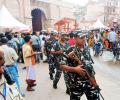
The Archaeological Survey of India (ASI) began working on a scientific survey of the Gyanvapi premises in Varanasi on Friday to determine whether the 17th-century mosque was constructed over a pre-existing structure of a Hindu temple.

Justice Padia stayed the Varanasi civil court order, ruling that the subordinate court passed its order ignoring the fact that the high court had reserved its verdict on the plea challenging the maintainability of the suit which had been filed earlier in the lower court for the survey.

A Varanasi court on Thursday reserved till October 21 its order on a plea seeking inclusion of the Gyanvapi mosque's 'wazookhana' in the ongoing Archaeological Survey of India (ASI) survey of the mosque complex.
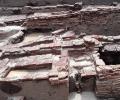
'It has the potential to sow seeds of furthering discord when the direction of the discourse is aimed at propagating the perceived supremacy of 'cultural nationalism' from a distant past over the prevailing dominance of 'Constitutional nationalism',' argues N Sathiya Moorthy.
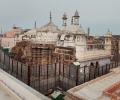
Advocate Madan Mohan Yadav, who is representing the Hindu petitioners, said, "The report in sealed cover was placed before the court by the ASI's standing counsel Amit Srivastava."
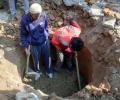
Two damaged idols were found inside the well of the Bhasma Shankar temple in Sambhal, Uttar Pradesh, India, which was reopened last week after being shut for 46 years. The temple, which houses an idol of Lord Hanuman and a Shivling, was reopened on December 13 after authorities stumbled upon the covered structure during an anti-encroachment drive. The idols, a Lakshmi idol and a Parvati idol, were found in the well, which authorities had planned to reopen. The district administration has written to the Archaeological Survey of India for carbon dating of the temple, including the well.
The court said the parties shall give an affidavit to keep the report with them and not make it public after getting the report.
The Allahabad high court on March 12 directed the Archaeological Survey of India (ASI) to undertake and complete the whitewashing at the mosque within one week.

The Archaeological Survey of India (ASI) has sought control and management of the Shahi Jama Masjid in Sambhal, Uttar Pradesh, citing its status as a protected heritage structure. The request comes after violence erupted during a court-ordered survey of the mosque, which was linked to a petition claiming that a Harihar temple once stood at the site. The ASI has argued that unauthorized changes to the mosque's structure by the management committee are unlawful and should be restricted. A three-member judicial commission has been formed to probe the violence and is expected to visit Sambhal on Sunday.
The court fixed December 11 as the next date of hearing in the matter, Yadav said.
A stepwell, approximately 125 to 150 years old and covering an area of 400 square metres, was unearthed during excavation in the Laxman Ganj area of Chandausi in Sambhal, an official said.

Amid the controversy over the 22 locked rooms in the basement of the Taj Mahal, the Archaeological Survey of India has released some photographs of closed underground cells.
The Bhasma Shankar temple in Sambhal, Uttar Pradesh, has reopened after being locked for 45 years following communal riots. The district administration has requested the Archaeological Survey of India (ASI) to conduct carbon dating of the temple, including a well on the premises. The temple is being guarded round the clock and worshippers have started visiting. The reopening of the temple has been met with gratitude from local residents, who have expressed their desire to reconnect with their heritage.

The Archaeological Survey of India on Sunday conducted scientific tests of the area under the three domes of Gyanvapi mosque in Varanasi on the third day of the scientific survey to determine if the mosque was built over a temple.
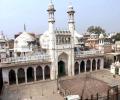
The Allahabad high court on Wednesday extended the stay on a survey of the Gyanvapi mosque premises by the Archaeological Survey of India till Thursday.

The ASI team, comprising more than a dozen members, reached the complex in the morning.
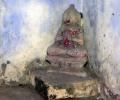
Devotees thronged the Khaggu Sarai area in Sambhal on Tuesday to offer prayers to an idol of Lord Hanuman that was discovered in the Bhasma Shankar temple, reopened last week after being shut for 46 years.
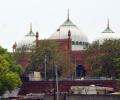
The objections against the suit were raised by the management committee of the mosque and the Uttar Pradesh Sunni Central Waqf Board.
A host of weapons, possibly used during the rebellion of 1857, was found by a farmer while working in his field in the district, an official said on Friday.

Five members of the Muslim side also participated in the survey. Its advocate Tauheed Khan said advocates of the Intezamia Masjid Committee Akhlaq and Mumtaz accompanied the survey team.


The Allahabad high court on Thursday reserved till August 3 its order on a plea against the survey of Gyanvapi mosque premises by the Archeological Survey of India.

The 'Maratha Military Landscapes', representing the Maratha rulers' fortification and military system, has been inscribed on the UNESCO World Heritage List, marking India's 44th property to receive this recognition.

The toll in the clashes between police and protesters opposing a court-ordered survey of a Mughal-era mosque in Sambhal, Uttar Pradesh, rose to four following the death of one more injured person, officials said on Monday.
The Supreme Court ordered on Monday that no invasive work would be undertaken by the Archaeological Survey of India (ASI) to determine if the Gyanvapi mosque located next to the Kashi Vishwanath temple in Varanasi was built upon a temple and agreed to hear a plea moved by the mosque committee during the day.
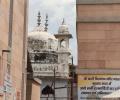
The Supreme Court's 2023 order refusing to stay a scientific survey at the Gyanvapi Mosque complex has sparked claims over several other disputed places of worship across India. This has led to several court cases, including one in Mathura where a survey of the Shahi Idgah Mosque complex was ordered, and another in Ajmer where a claim was made that a Shiva temple existed within the dargah of Sufi saint Moinuddin Chishti. The article also highlights a dispute over the Bhojshala in Madhya Pradesh, which Hindus consider a temple and Muslims consider a mosque. The Supreme Court's order has reignited debates about the Places of Worship (Special Provisions) Act, 1991, which prohibits the change of character of religious places as they existed on August 15, 1947.

The theme for this year is "Yoga for One Earth, One Health" echoes India's vision of global wellness.
Aggrieved by the direction, Dhar city's head cleric Waqar Sadiq said they (Kamal Maula Mosque management committee) will challenge the ruling in the Supreme Court.
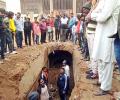
The Supreme Court of India has ordered a status quo on a private well located near the entrance of the Sambhal Jama Masjid, prohibiting any action regarding the well without its permission. The order came in response to a plea by the mosque's management committee, which challenged a lower court order that allowed a survey of the mosque, citing concerns over violence and loss of life during previous surveys. The court also instructed the authorities to file a status report within two weeks.

After MNS threat, some people in Khultabad area, where the tomb is located, tried to lock the structure.
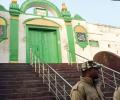
The Uttar Pradesh government has informed the Supreme Court that the disputed "private well" near the Mughal-era Jama Masjid mosque in Sambhal was situated on public land. The state government said the petitioner failed to disclose there was a well within the boundary walls of the mosque known locally as "yagna koop". The committee, in a spot inspection, found that the well was situated outside the mosque boundary wall, the report said. The report said the state was committed to ensuring peace and harmony in the region and any restraint on the use of such public wells by the community at large may not help in achieving that goal.

The Allahabad high court on Thursday allowed the Archaeological Survey of India (ASI) to conduct a scientific survey at the Gyanvapi premises in Varanasi to determine whether the 17th-century mosque has been constructed over a pre-existing structure of a Hindu temple.
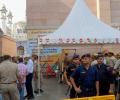
Rakhi Singh has accused the Muslim side of destroying Hindu symbols on the Gyanvapi premises and demanded protection of the entire complex in order to ensure that these symbols are not lost.
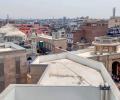
The Allahabad high court on Tuesday extended the interim stay till September 30 on a Varanasi court order directing the Archaeological Survey of India to conduct a physical survey at the Kashi Vishwanath temple-Gyanvapi mosque complex and further proceedings in this case.

The apex court rejected an appeal challenging a July 10 decision of the Allahabad high court which had also dismissed the plea finding no error or illegality in the order of a Mathura civil judge who had decided to first hear the issue of maintainability of the suit as raised by management committee of the mosque.

Seven FIRs have been lodged in connection with the violence over a court-ordered survey of a Mughal-era mosque in Sambhal, Uttar Pradesh, naming Samajwadi Party MP Zia-ur-Rehman Barq and local SP MLA Iqbal Mehmood's son Sohail Iqbal as accused. Three people were killed and scores of others injured on Sunday as protesters opposing the survey of the Shahi Jama Masjid clashed with police. The district administration has imposed prohibitory orders and barred the entry of outsiders into Sambhal till November 30.
